
Colonel William Hemsley, Cloverfields and Wye Mill during the War for Independence
/Celebrating the 250th Anniversary of the United States
April 19, 2025 marked the 250th anniversary of “the shot heard round the world,” the now-iconic phrase that refers to the first discharge of gunfire at the Battle of Lexington in Massachusetts. This clash between British regulars and the colonial militia at Lexington Green, along with the same-day skirmish at nearby Concord, signified the beginning of the American Revolutionary War.
To commemorate the events taking place between the start of the conflict and the war’s end with the 1783 signing of the Treaty of Paris, we will take time to examine Col. William Hemsley's (1736-1812) wartime endeavors. In this issue, Rachel Lovett explores Hemsley’s military service and the many challenges he experienced as a colonel in the 20th Battalion of the Queen Anne’s Militia. We also examine Hemsley's other role as a procurement officer for the Continental Army.
Integral to that story is Wye Mill, located about a mile east of Cloverfields in the village of the same name. Hemsley owned Wye Mill during most of the war and received orders from the Maryland Government’s Council of Safety to have wheat ground at that location for shipment to Gen. George Washington's troops at Valley Forge, Pennsylvania.
Purchasing agents never feature as the hero of war movies, but to George Washington's famously beleaguered and underfed troops, these armed administrators were critical to victory. On Maryland's Eastern Shore, the “breadbasket of the Revolution,” it was a particularly hazardous and largely thankless job.
Feeding Revolution
“An army marches on its stomach.” This familiar statement, attributed to both Napoleon and Frederick the Great, cautions commanders that military success is closely tied to a well-fed fighting force. Throughout the American Revolution, the Continental Congress struggled to adequately supply Gen. George Washington’s Continental Army, a reality made famous by the legendary hardships troops faced at Valley Forge, Pennsylvania, during the winter of 1777-1778. From Washington’s letters, we know that the chronic shortages of food, clothing, and ammunition plaguing the army jeopardized its survival and, with it, the independence of the new nation.
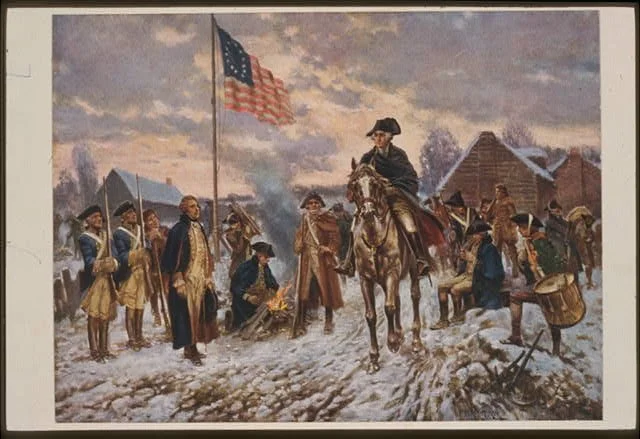
Figure 1: George Washington on horseback in snow at Valley Forge by Percy Moran (1862-1935), ca. 1911. George Washington and the Continental Army’s sufferings at Valley Forge became a popular subject in art, symbolizing American resilience. Source: THe Library of Congress.
In helping Washington fight the battle against hunger, Maryland’s Eastern Shore punched well above its metaphorical weight. By the time war broke out, farms on the Maryland portion of the 180-mile-long, three-state Delmarva Peninsula (made up, as the name suggests, of portions of Delaware, Maryland, and Virginia) had shifted away from traditional mono-crop tobacco farming by adding large quantities of wheat and corn to the agricultural mix. Not only did grain grow in abundance here, but the vast shoreline created by the Atlantic Ocean and the Chesapeake Bay stymied British and Tory attempts at an effective shipping blockade. As a result, the region became such a vital source of army food stores that historian Charles Truitt described Maryland’s Eastern Shore as “The breadbasket of the Revolution.” [1]
By 1777, Col. William Hemsley commanded the Twentieth Battalion of the Queen Anne’s County Militia. He also held key elected and appointed offices, including serving as a representative for Maryland in Philadelphia at the Second Continental Congress. Arguably, the colonel’s most significant contribution to the Patriot cause was not in his capacity as a military officer or statesman, but as a procurement agent, purchasing and shipping supplies to Washington’s often-desperate troops in the north.
Provisioning an army may sound mundane and routine, but it was a challenging and sometimes hazardous task. The cheerful myth of the American Revolution is the story of freedom-loving colonists rising as one to overthrow British tyranny. That presentation is far from accurate. The American Revolution was a civil war fought not just between armed American and British forces, but also between pro-independence Patriot colonists and their Loyalist neighbors, also known as Tories, who wanted to stay under British rule. Compelling crops, livestock, and money from the war’s supporters was difficult, but doing so from those downright hostile to the cause proved perilous.
Loyalist sentiments ran high on Maryland’s Eastern Shore. In neighboring Kent County, planter James Chalmers recruited over 300 men to form the First Battalion of Maryland Loyalists. Isaac Atkinson, a landowner in Somerset County, attempted a rebellion by trying to persuade members of the county militia to switch allegiance and side with the British. Methodist minister Cheney Clow received a British commission, raised a fighting force, and went so far as to build a fort along the border between Maryland and Delaware. [2]
Along the peninsula, Loyalists acted as British scouts, attacked procurement officers, interfered with recruitment efforts, and stole supplies. Tory sea captains in the lower Chesapeake —pirates in the view of the new state government— routinely interfered with shipping. British raiding parties and their Loyalist surrogates looted farms and attacked the residences of local militia. Several raids took place within a few miles of Cloverfields, including that on Col. Edward Lloyd IV’s Wye House, located four miles south of Cloverfields. [3]
We do not know if Col. Hemsley struggled with his decision to back the revolution, but the issue divided his extended family. Col. Hemsley’s Loyalist uncle, James Tilghman (1716-1793), spent the first part of the war under house arrest, and his teenage son, Philemon Tilghman (1760-1797), ran away to join the Royal Navy. (Still impulsive as an adult, Philemon outraged both families when he audaciously eloped with his commanding officer’s daughter in 1785.)
The actions of his father and brother must have been a painful embarrassment to Tench Tilghman (1744-1786), James’s older son and Hemsley’s first cousin, who served with distinction and without pay as Washington’s aide-de-camp through the duration of the war. [4] It was Tilghman that Washington entrusted with delivering to the Continental Congress in Philadelphia the triumphant news of Gen. Cornwallis’s surrender at Yorktown, Virginia.
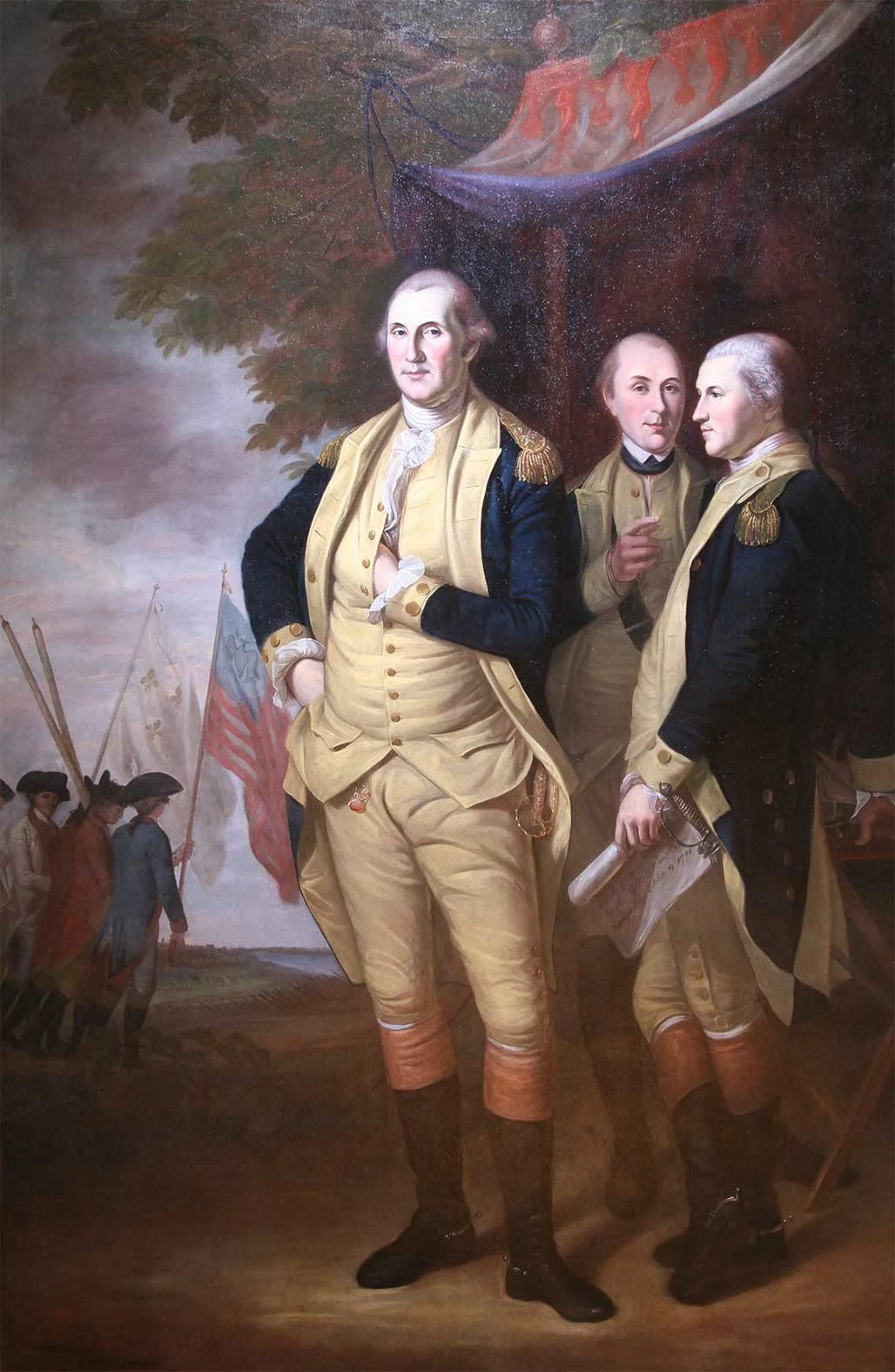
Figure 2: Tench Tilghman is depicted on the right side of this painting, titled Washington, Lafayette & Tilghman at Yorktown, by Charles Willson Peale (1741-1827). Tilghman’s Loyalist father and brother exemplify the deep political divisions at play on Maryland’s Eastern Shore. Source: Maryland State Archives.
Even when they weren’t actively involved in insurrection against the new government, many Eastern Shore farmers were hesitant to sell provisions to procurement officers. Their objection was often financial rather than political. Farmers routinely complained about the price at which they were compelled to sell their crops and livestock, the quantity they were required to relinquish, and receiving payment in the form of promissory notes or dubious Continental currency. Hemsley wrote to Gov. Lee, complaining about the lack of “hard money” that “in transactions between man and man, paper money does not pass at all.” [5]
Procurement officers, such as Hemsley, found themselves caught between a government desperate to acquire supplies and unaccommodating farmers, who were either worried about their livelihoods or opposed to the cause. Maryland’s Council of Safety, the wartime government body responsible for the state's defense and enforcing the dictates of the Continental Congress, was quick to demand supplies but slow to pay for them, sometimes requiring procurement officers to self-fund purchases.
In 1778, William Hemsley purchased Wye Mill from Edward Lloyd IV (1744-1796). In Hemsley, the Council had someone who offered the valuable combination of financial experience, owned a grain mill and a ship authorized for use as a privateer, and commanded the local militia. [6] The following year, Hemsley received a £10,000 order for supplies, including wheat to be ground at his own mill and sent to the Continental troops. This exceptionally large amount, more than ten times the typical purchase order, made to county officers, reflects the trust and confidence the Council had in Hemsley. [7]
For Col. Hemsley and others in his position, frustrations and hazards persisted throughout the war and into the years of the new republic. With the surrender of Cornwallis at Yorktown, Virginia, on October 19, 1781, and cessation of large-scale hostilities, the need for supplies diminished but did not disappear.
The Introduction to Journal and Correspondence of the State Council, 1781-1784, which covered post-surrender activities, writes of the need to keep Maryland troops supplied with food and clothing until units were disbanded, to guard prisoners of war, to send supplies to Maryland prisoners confined in British ships in New York, to suppress small enemy vessels operating in the Bay, to conciliate soldiers clamoring for their pay and “to do all these and innumerable other things not with hard money which was well nigh unobtainable, but with bills of credit, dubiously secured and paper currency rapidly depreciating in value.”[8]
In Founding Brothers: The Revolutionary Generation, Joseph P. Ellis wrote, “No event in American history which was so improbable at the time has seemed so inevitable in retrospect as the American Revolution.” The colonists achieved a shocking victory over the world's largest empire and most powerful military not just through actions audacious and spectacular, but also in accomplishing the unexceptional and ordinary. Col. Hemsley’s service as a procurement officer provides an important reminder of that and makes clear that even undistinguished deeds were essential and sometimes dangerous.
[1] Barrie Paige Neville, “For God, King, and Country: Loyalism on the Eastern Shore of Maryland During the American Revolution.” International Social Science Review 84, no. 3/4 (2009), 145-147. http://www.jstor.org/stable/41887408.
[2] Leonard Szaltis. Chesapeake Bay Privateers in the Revolution (Charleston: The History Press, 2019), 23.
[3] Mildred C. Schoch. The Endeavours and Exertions of Queen Anne’s County, Maryland During the Revolutionary War, 1775-1783 (Annapolis: Maryland State Archives, 1976), 97.
[4] Tench Tilghman served without pay until 1781 when Gen. Washington arranged for him to receive a regular commission in the Continental Army. Washington called Tilghman “a zealous servant and slave to the public, and a faithful assistant to me for near five years.” https://msa.maryland.gov/msa/mdstatehouse/html/committeerm_wlt.html
[5] Schoch. Endeavours and Exertions, Endeavours and Exertions, 33.
[6] Edward C. Papenfuse. A Biographical Dictionary of the Maryland Legislature, 1635-1798 (Annapolis: Maryland State Archives, 1979), 432. https://msa.maryland.gov/megafile/msa/speccol/sc2900/sc2908/000001/000426/html/am426--432.html.
[7] Schoch. Endeavours and Exertions, 58-59.
[8] Schoch. Endeavours and Exertions, 91.
Recent Visitors
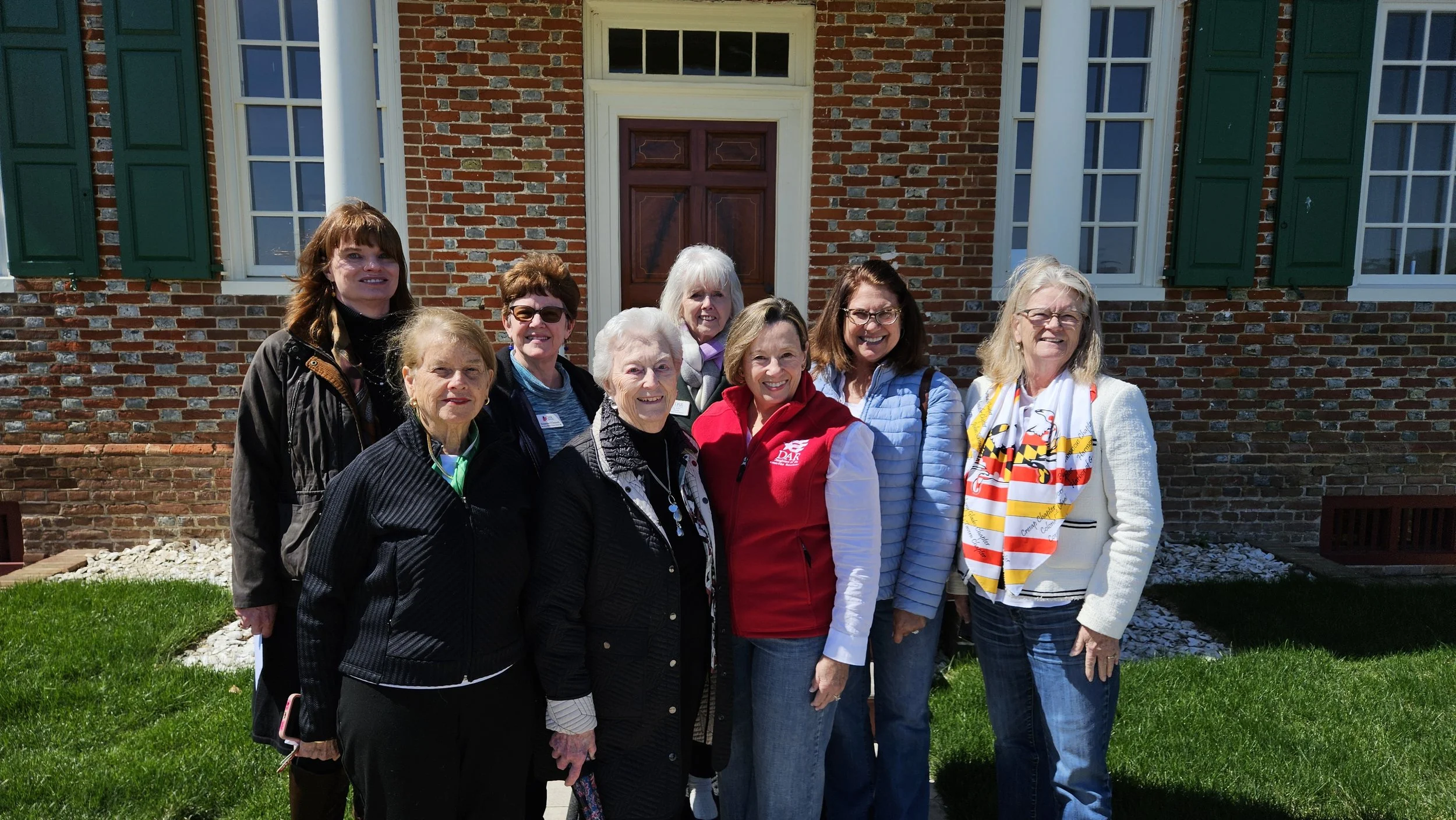
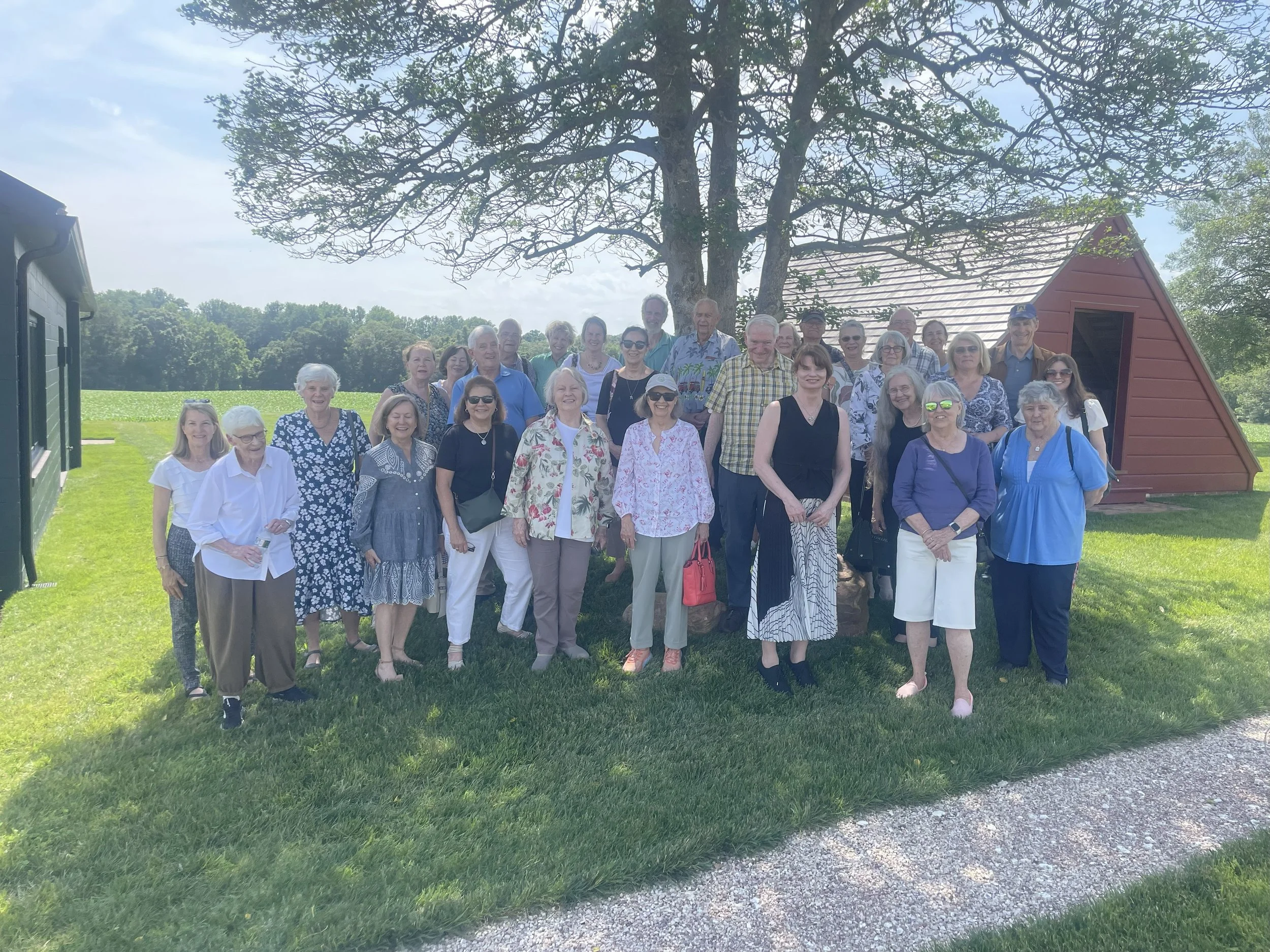
Cloverfields welcomed a variety of groups this spring, including the General Perry Benson Chapter of the Daughters of the American Revolution (Above), the staff and Board of Directors of Historic Annapolis, and the docents from the Hammond-Harwood House in Annapolis (below).
Views from the Garden
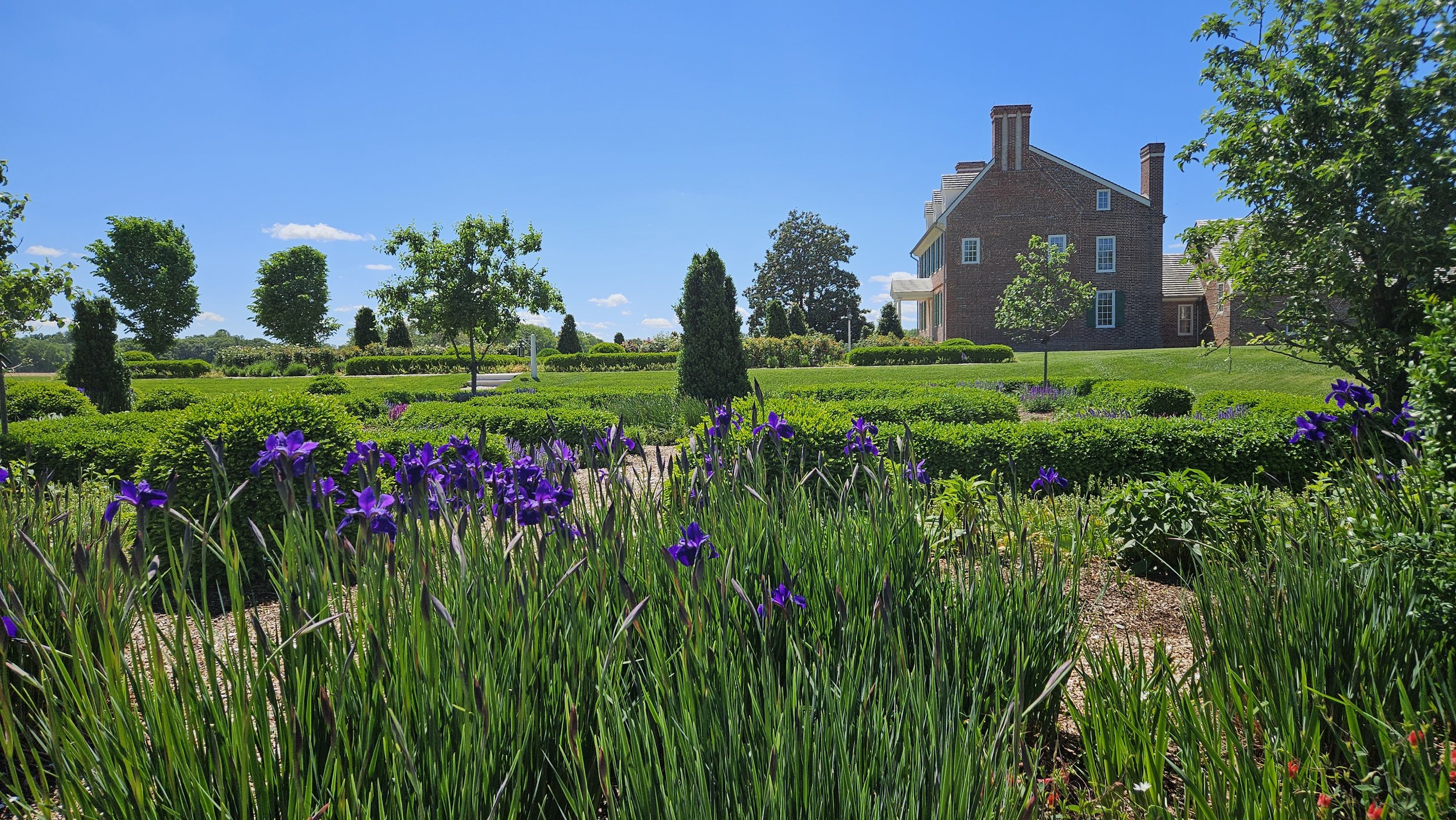
As Spring’s Tulips faded, the Irises came into full bloom. Photo BY Sherri marsh Johns.
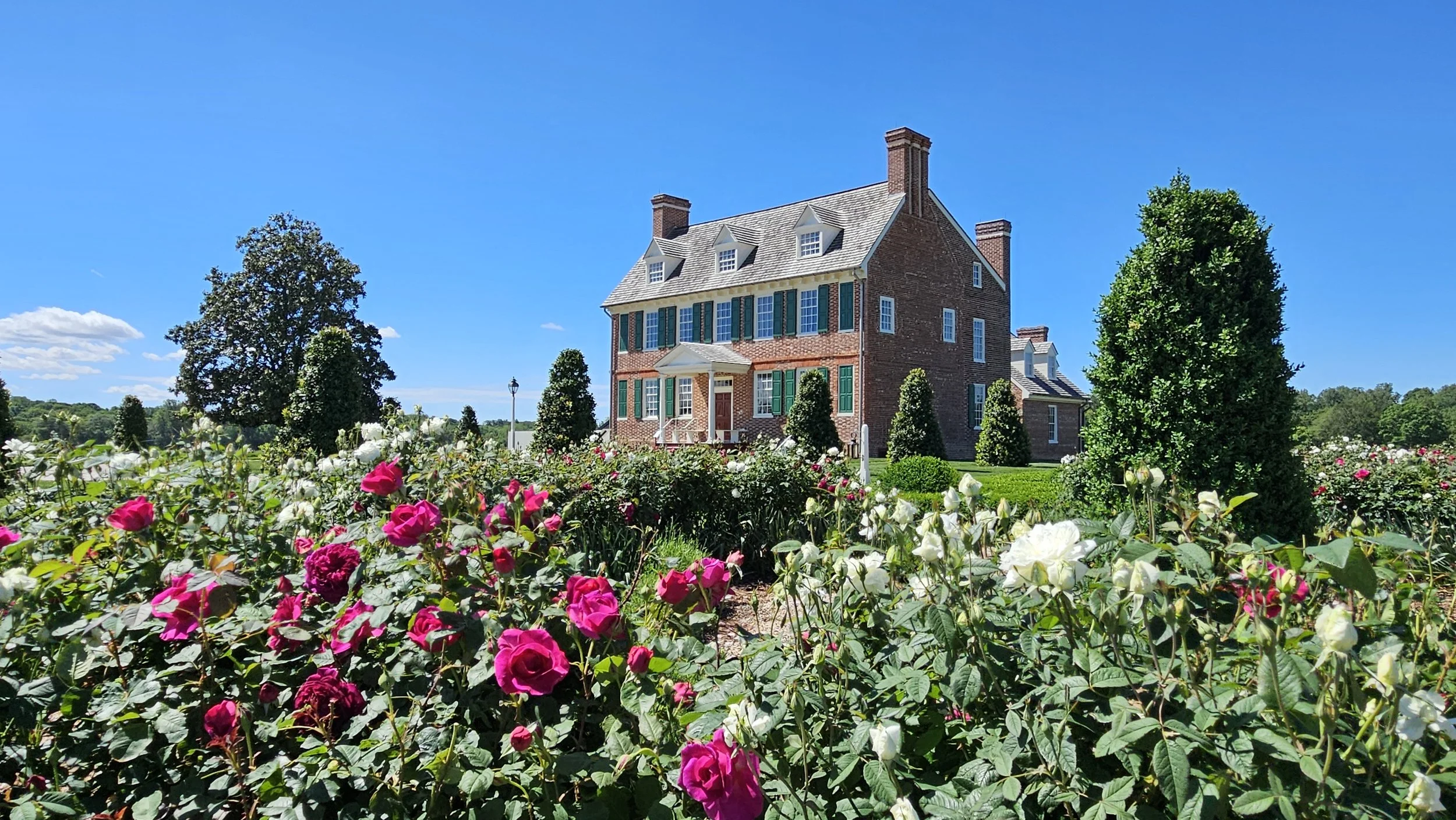
Roses now perfuming the summer air. Photo by Sherri Marsh Johns.
Cloverfields Preservation Foundation Enters into a Partnership with the Friends of Old Wye Mill

Figure 1: According to the National Register of Historic Places, Wye Mill is an important early industrial landmark. A mill has operated on or near this site since 1668. Photo by Willie Graham.
CPF is excited to announce it has completed the purchase of historic Wye Mill and entered into a partnership with the Friends of Old Wye Mill (FOWM). Listed on the National Register of Historic Places, this important landmark of early American industry is recognized as one of the oldest continuously operating water-powered grist mills in the United States. Dendrochronology dates the current structure to 1754, but a grain mill has operated on site since at least 1682. William Hemsley (1736-1812) purchased it from Edward Lloyd IV in 1778, and it remained in the Hemsley line until descendants sold it to the Hopkins family in 1845.
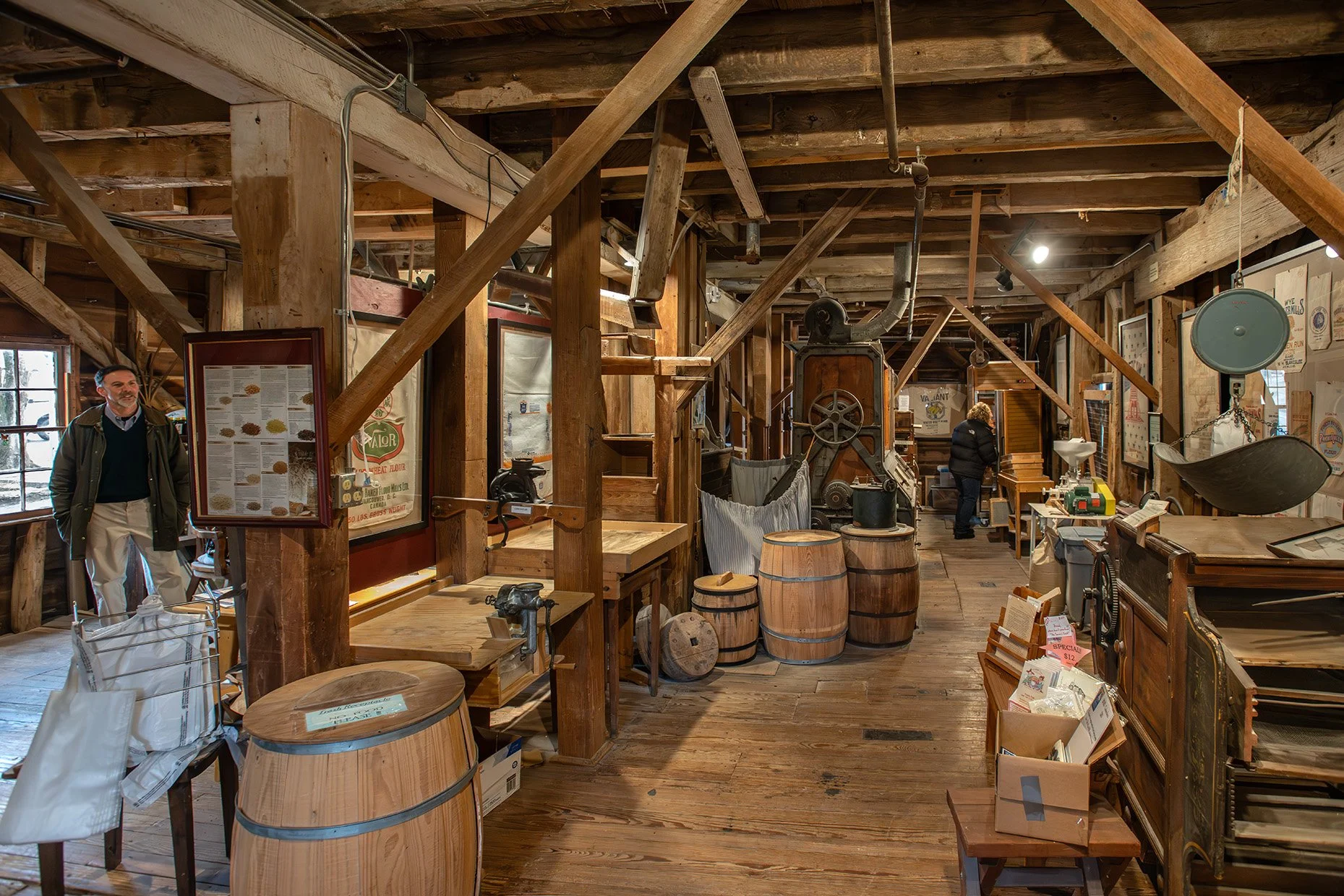
Figure 2: Wye Mill Interior. Photo by Willie Graham.
CPF will make repairs to the historic structure and provide additional improvements to enhance the visitor experience. FOWM, who have owned the building since 1996 will continue to manage day-to-day operations, including offering public milling demonstrations and the sale of fresh stone-ground flour and meal. Old Wye Mill is now open for the season. For more information, visit their website at https://www.oldwyemill.org/
Leader in Liberty: Colonel William Hemsley’s Role in the American Revolution
by Rachel Lovett, Collections Consultant
The Cloverfields Preservation Foundation recently acquired at auction a Revolutionary War–era letter written by Colonel William Hemsley, dated March 17, 1781, concerning the procurement and delivery of ammunition. This exciting acquisition has renewed interest in Hemsley’s role during the American Revolution—particularly timely as we approach the 250th anniversary of the nation’s founding. While the letter reveals one specific moment in time, the content helps piece together a puzzle of March 1781, a time fraught with Loyalist raids on the Eastern Shore.
To help understand this letter in context, a timeline of Hemsley’s involvement can be created to illustrate his leadership, character, and contributions to the revolutionary cause.
The American Revolution spanned over eight years, beginning with the first shots fired at Lexington and Concord, Massachusetts on April 19, 1775, and concluding with the Treaty of Paris on September 3, 1783. Unlike 20th-century wars, the Revolution was mainly fought at home, through the everyday efforts of citizens. On Maryland’s Eastern Shore, Colonel William Hemsley (1737–1812), the third-generation owner of Cloverfields, was a key figure who recruited troops, secured supplies, and helped maintain political order during a time of profound upheaval.
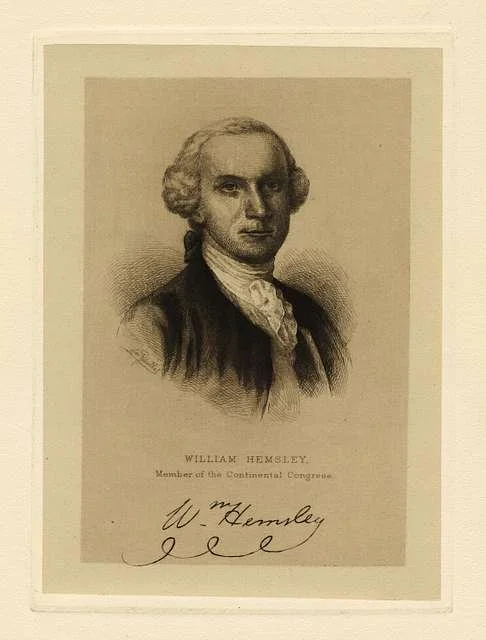
Figure 1: Etching of William Hemsley, “Member of the Continental Congress by Max Rosenthal (1833-1918), ca 1885. Source: New York Public Library’s Public Domain Archive.”
By summer 1776, news of the Declaration of Independence had spread rapidly. Communities on the Eastern Shore, including Queen Anne’s County, mobilized quickly. Thirty-nine-year-old Hemsley emerged as a trusted leader. In September, he attended a key militia meeting at Kent Island where officers were elected. By December, he was appointed to Maryland’s Council of Safety, an essential wartime body overseeing local defense, implementing revolutionary policies, and maintaining civic order amid uncertainty.[1]
The 1776 Maryland census offers a snapshot of Cloverfields at the outset of the war. The household included adult men and women, likely comprising Hemsley, his wife, siblings, in-laws, and children. Like many contemporaries, Hemsley held enslaved individuals—44 in total, according to the census—reflecting the scale of his domestic and agricultural operations that supported his public duties during the Revolution.[2]
In 1777, Hemsley’s military leadership expanded. In June, he corresponded with Maryland Governor Thomas Johnson about militia enrollments and officer commissions. By August, he reported having two battalions, totaling approximately 600 men, but highlighted shortages of vital supplies, including tents and blankets.[3] Lack of supplies was not the only setback. Smallpox was also a constant threat to the troops and citizens alike. In a June 14 letter from Hemsley to Governor Johnson, he noted, “Thomas has been delayed by being inoculated.”[4] Smallpox is a highly contagious and often deadly disease that causes fever and rash. Having survived smallpox as a teenager in Barbados, George Washington had firsthand knowledge of its dangers. In 1777, he ordered the systematic inoculation of the Continental Army, which dramatically reduced fatalities.[5] In December 1777, after a year on the Committee of Safety, Hemsley resigned—likely to attend to family matters as his wife Sally gave birth that year to their fifth child, Philemon.
The following year, Hemsley managed volatile local tensions. In February 1778, the Council of Safety tasked him with deploying militia to assist the sheriff in quelling unrest over substitute money—a controversial tax to fund military replacements. Throughout spring, Hemsley contended with escalating Tory violence and raids, including attacks led by the notorious Cheney Clow, a Methodist minister originally from Maryland. In April 1778, Clow rallied a force of about 200 men and fortified a stronghold near the Maryland–Delaware border to resist Patriot rule.[6] His actions led to clashes with local militia. Initially evading capture, Clow was finally caught in 1782, imprisoned, tried for treason and murder, and hanged a few years later. His uprising underscored the deep and volatile divisions at home between Loyalists and Patriots, revealing that the battle for independence was not only fought on distant fields, but within Maryland’s own communities.
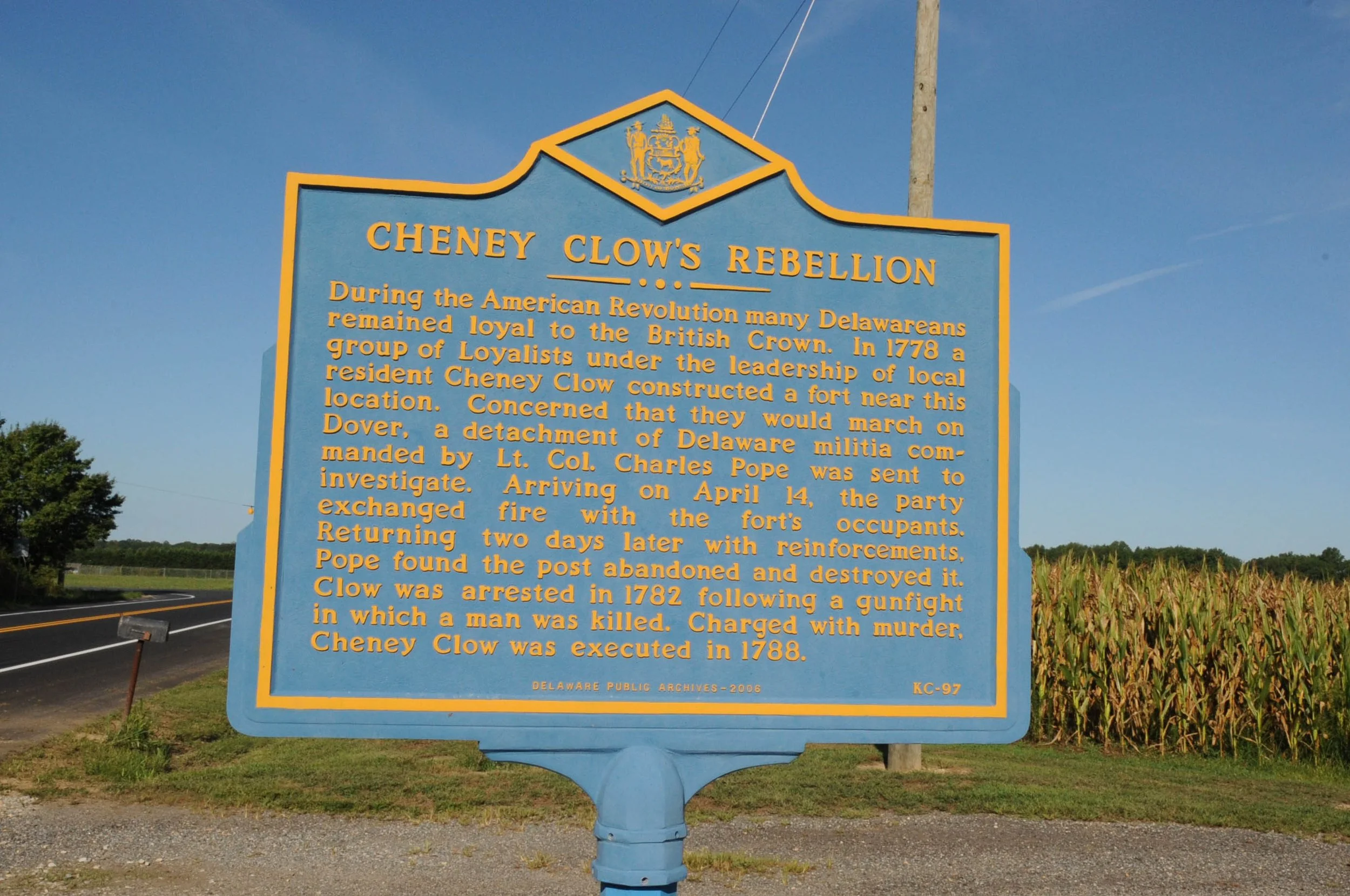
Figure 2: Historical Marker for the site of Clow’s Rebellion, Kenton, Delaware.
Meanwhile, Hemsley faced delicate family issues. His wife was pregnant with their daughter Sarah, and in March, his cousin Edward Tilghman Jr. was arrested for unauthorized travel to British-occupied Philadelphia. Over several months, Edward petitioned to travel again, including a request to visit nearby Cloverfields in April, and ultimately received permission to move freely again by late July. Amid these challenges, Hemsley also oversaw the procurement of essential provisions such as the ingredients for ship’s bread, a dense type of cracker, for the Continental forces.
By 1779, Hemsley’s focus shifted toward logistics and administration. He coordinated and stored 10,000 barrels of flour for the Continental Army while balancing local supply demands. That year, he was elected to the Maryland State Senate and appointed to a commission expanding the Governor and Council’s authority, reflecting increasing trust in his leadership. His wife gave birth to their seventh child that year, Henrietta Maria, marking the third birth in three years.
In 1780, despite personal illness and setbacks, Hemsley’s determination remained unwavering. In July, he wrote urgently to Maryland Governor Thomas Sim Lee about deteriorated jail conditions in Queen Anne’s County, the high costs of housing recruits and deserters, and the need for funds and supplies. He even sheltered soldiers at Cloverfields while awaiting support. The Council authorized £6,000 to aid recruitment, and by mid-August, Hemsley had enlisted 31 men—despite suffering a severe fever. He also coordinated flour shipments and managed enlistment logistics.
The year 1781 provides the most vivid and demanding portrait of Hemsley’s service during the Revolution. A letter written by Hemsley, dated March 14, 1781, to Governor Lee describes a harrowing experience for his friends and neighbors, Colonel Edward Lloyd, John Beale Bordley, and William Paca.
“About two o’clock today I received a letter from Colonel P. Tilghman informing that the enemy landed at Col. Lloyd’s this morning at 1 o’clock and plundered him of all his plate, money, clothes, etc. then went to Beal Bordley’s who shared the same fate, they were twelve in number; in two barges. They used no violence to either of the two families, but kept the Col. Safe until they had done their business lest he should alarm the neighborhood. I have just received a letter from Mr. Richard Tilghman, to whom Mr. Paca writes he was attacked by about 20 or 30 refugees who came in a barge and plundered to the amount of 500 pounds hard money and Mr. Paca’s overseer says Mr. Bordley had scarce anything left. Colonel Lloyd lost 7 negroes Mr. Bordley 3. I have scarce not been able to collect any intelligence where the vessel lay, the men landed from. Therefore concludes they must have rowed up from Poplar’s Island. Mr. Matthew Tilgman went from the special council with 50 men well armed and one field piece down to the Bay Side. I shall get out of the classes for this county tomorrow and hope you’ll have some persons ready to receive the recruits should any be obtained.”[7]

Figure 3: Charles Willson Peale (1741-1847), The Edward Lloyd Family, Maryland 1771. Oil on Canvas. Source: Winterthur Museum.
The threat was immediate and close at hand. Just three days later, on March 17, Hemsley wrote the letter recently acquired by the Foundation, highlighting how the war had reached his doorstep and how he continued to fulfill his duties despite the danger to his property and family at Cloverfields.
The letter reads:
"You [are to] please order Capt. Falkner to collect the Arms with all the Accoutrements that were delivered him & send them down to Queens Town under the care of some trusty person, to Mr. Robt. Wright - desire him to send a list of what he does send - I would have you get the Arms in your possession put into order, & distribute them into such active Hands as you can rely on. Make use of the lead as far as wanted, & have 40 or 50 rounds of Cartriges for each muskett made up, & take the persons each to whom you deliver the muskett & c. and the number of Cartridges - Give strict orders that they do not fire away the powder & ball - I will pay the expenses of bringing the arms down." At verso: "Colonel Jno. Thompson / The Doct'r is requested to forward this, this Evening".
While historians have long known about the Loyalist raid on his friends’ estates, this letter provides new insight into Hemsley’s immediate response. Despite the threat so close to home, he remained focused on his responsibilities, ordering the collection and redistribution of arms and covering the related expenses himself. Among those mentioned in the letter is Robert Wright, a lawyer and militia captain from the Eastern Shore who later served as Governor of Maryland and a United States Senator.
Throughout 1781, Hemsley continued to navigate recruitment challenges, the strain on families, and the instability of currency. He personally oversaw exemptions and substitutes and advocated for neighbors, such as Joseph Gould, a poor young man supporting five siblings, who requested an exemption from service.[8] This decision reflects Hemsley’s effort to balance the demands of wartime service with an awareness of the personal difficulties facing those in his community.
As British raids continued into the summer, defensive efforts such as subscription-funded barges guarded the Bay. In September, Hemsley helped with logistics to secure horses for officers, including Colonel Tench Tilghman, aide de camp to George Washington.[9]
Although the majority of the fighting effectively ended with the British surrender at Yorktown in October 1781, Hemsley’s public service continued. After completing his term in the Maryland State Senate, he served in the Continental Congress in 1782 and 1783, participating in the nation’s transition from war to peace. In 1784, he returned to Cloverfields, focusing on farming and renovating the family home—signaling a new chapter after years of intense Revolutionary service.
Colonel William Hemsley emerged as a leader during the Revolutionary turmoil, demonstrating resilience and unwavering resolve. Many of his descendants have carried forward these same qualities. His legacy of service and sacrifice remains a powerful reminder of the quiet strength that helped shape the nation, especially as we reflect on 250 years of American independence.
This work would not have been possible without the dedication of the late historian Mildred C. Schoch, whose quiet commitment helped preserve the Revolutionary legacy of Queen Anne’s County. As a member of the Bicentennial Commission in 1975, she painstakingly compiled every available primary document on this topic from the Maryland State Archives. In her introduction, she wrote with humility, “It is hoped that historians… will find this study useful and interesting.” Thanks to her efforts, generations later, we still can.
[1] Mildred Schoch, The Endeavours and Exertions of Queen Anne’s County, Maryland During the Revolutionary War 1775-1783 (Maryland: Queen Anne’s County Bicentennial Committee, 1975), 23.
[2] Maryland Colonial Census, Queen Anne’s County, 1776.
[3] Schoch, Endeavours and Exertions, 26.
[4] Schoch, Endeavours and Exertions, 25.
[5] Ann M. Becker, Smallpox in Washington's Army Disease, War, and Society During the Revolutionary War (Lanham, MD: Lexington Books, 2022), 34.
[6] Dee E. Andrews, The Methodists and Revolutionary America, 1760-1800 The Shaping of an Evangelical Culture (Princeton: Princeton University Press, 2010), 57-58.
[7] Schoch, Endeavours and Exertsions, 97.
[8] Schoch, Endeavours and Exertsions, 34.
[9] Schoch, Endeavours and Exertsions, 109.